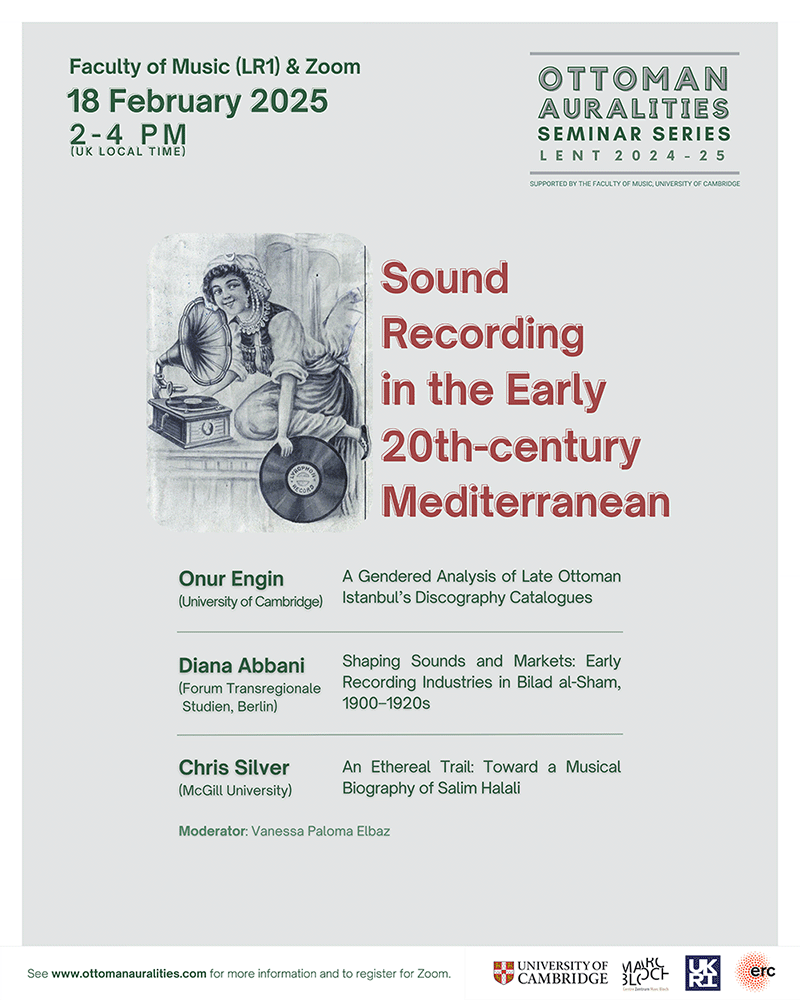
18 February 2025 | 2:00-4:00pm on Zoom &
in Lecture Room 1, Faculty of Music, University of Cambridge
Diana Abbani (Forum Transregionale Studien, Berlin)
Shaping Sounds and Markets: Early Recording Industries in Bilad al-Sham, 1900–1920s
A 1906 letter from Karl Friedrich Vogel, a German concessionaire for Gramophone in Bilad al-Sham [the Levant], to his London-based director Theodore B. Birnbaum, offers a fascinating glimpse into the dynamics of the nascent recording industry. The letter highlights the alarming activities of two key figures in Beirut’s recording scene: Setrak Mechian, Odeon’s Armenian agent, who would later establish Mechian Records in Egypt, and Farajallah Baida, a Syrian singer who, together with his cousins, would go on to found Baidaphon, the first Arabic record label. At the time, Mechian was accused of illicitly copying records, reflecting the competitive and often contentious environment multinational recording companies faced as they expanded into the Ottoman Empire. These anecdotes underscore the interplay between commerce, competition, and cultural production, revealing how international companies sought to dominate emerging markets while local agents innovatively adapted recording technologies to meet regional needs.
This paper examines the early years of the recording industry in Bilad al-Sham, exploring its role in facilitating cultural exchange and shaping collective imaginaries during a period of nationalist discourses’ emergence. Concentrating on the first two decades of the 20th century, it investigates the circulation of early recordings, the mobility of artists, and the integration of emerging technologies into cultural life. While these recordings were primarily commercial ventures, they also began to reflect traces of collective identities through their local adaptations and transregional reach. By analyzing the interplay between technology, commerce, and cultural production, this paper argues that the early recording industry laid the groundwork for the musical and political transformations that would later shape Bilad al-Sham and beyond.
Diana Abbani is a cultural historian of the Modern Middle East, currently working as the science communication coordinator of the Merian Center for Advanced Studies in the Maghreb (MECAM), at the Forum Transregionale Studien, Berlin. She holds a PhD in Arabic Studies from Sorbonne University and has been awarded postdoctoral fellowships from the Forum Transregionale Studien and the Fritz Thyssen Foundation. Her research focuses on the intersections of popular culture, social and political transformations, and the emergence of music and entertainment industries in the region. She has published extensively on Beirut’s cultural history and is currently working on a book that explores alternative narratives in Bilad al-Sham’s musical history, highlighting the experiences of marginalized communities during periods of sonic transformation.
Chris Silver
Chris Silver (McGill University)
An Ethereal Trail: Toward a Musical Biography of Salim Halali
The legendary Algerian Jewish musician Salim Halali (1920-2005) was considered by his peers to have had “the most beautiful Arab male voice of the postwar era.” By mid-twentieth century, that designation had also made him the best-selling North African artist of his time through the preferred technological medium of the period: the 78 rpm record. Indeed, in the two decades following his 1939 commercial debut, his dozens of releases and thousands of discs sold for the Pathé label invigorated anti-colonial nationalist movements, provided Maghribi modernity with one of its soundtracks, and even animated the synagogue service as his melodies were rendered in contrafacta. And yet, despite his prodigious output and the esteem with which he was held by so many and for so long, his biography has proved elusive. This paper proposes that his border-crossing, including in the realm of music, may have played a role in the silencing of his story. Likewise, his movement across boundaries and genres was almost certainly central to his success. Born in eastern Algeria (not far from Tunisia), coming of professional age in interwar France, marooned in Nazi-occupied Paris during the Second World War, and traversing the Mediterranean before settling in Casablanca in the years prior to Moroccan independence in 1956, Halali may have left little by way of the paper documents preferred by historians but did leave an ethereal trail through his recorded music. This paper, therefore, aims to construct a musical biography of Salim Halali from his surviving phonograph records. In doing so, it endeavors to fashion a model for future such studies of twentieth century musicians from North Africa and the Middle East moving forward.
Christopher Silver is the Segal Family Associate Professor in Jewish History and Culture at McGill University. Recipient of awards from the Social Sciences and Humanities Research Council of Canada, the American Academy of Jewish Research, the American Institute for Maghrib Studies, the Association for Recorded Sound Collections, and the Posen Foundation, Silver’s scholarship on history and music has appeared in the International Journal of Middle East Studies, Jewish Social Studies, Hespéris-Tamuda, AJS Perspectives, History Today, and the United States Holocaust Memorial Museum’s Holocaust Encyclopedia. His first book Recording History: Jews, Muslims, and Music Across Twentieth Century North Africa (Stanford University Press, 2022) was awarded the L. Carl Brown AIMS Book Prize by the American Institute for Maghrib Studies for outstanding book in North African studies (2023) and a Certificate of Merit for Excellence in Historical Recorded Sound Research by the Association for Recorded Sound Collections (2023). Recording History is now set to be published in Arabic as Al-Musiqa w-al-ghina fi qalb al-tarikh al-yahud w-al-muslimin al-buldan al-magharibiya, trans. by Khalid Ben-Srhir (Rabat: Manshurat kulliyat al-adab wal-ʿulum al-insaniya, Jamiʿat Muhammad al-khamis, 2025). He is also the founder and curator of the website Gharamophone.com, a digital archive of North African records from the first half of the twentieth century.
Onur Engin (University of Cambridge)
A Gendered Analysis of Late Ottoman Istanbul’s Discography Catalogues
The Ottoman Empire, home to various ethnic, cultural, and religious communities, witnessed how each community’s unique music culture influenced record companies and their discographies. A detailed analysis of these catalogues offers valuable insights into how societal values, collective emotions, and political realities of this tumultuous period were expressed.
This paper examines the interplay of gender and musical production in late Ottoman Istanbul through a computational analysis of its discography catalogues. Analyzing a custom dataset comprising over seven thousand songs released by nine record labels, it provides a quantitative approach to reexamine the music history of the Ottoman Empire. Focusing on the popular musical genres, artists, maqams, and songs of the period through data visualization and network theory, it demonstrates how these records serve as sonic/material representations of cultural exchange and gender differences in the Ottoman music industry. Exploring collaboration networks, it identifies central figures, record labels, and clusters of artists who frequently partnered with female musicians. The study also compares the distribution of genres, maqams, and record labels between male and female musicians to highlight biases.
Onur Engin is a Postdoctoral Research Associate at the Faculty of Music, University of Cambridge. He is working on an ERC Starting Grant funded by UKRI, titled “Ottoman Auralities and the Eastern Mediterranean: Sound, Media, and Power, 1789-1914.” He earned his PhD in Art History from Koç University in Istanbul. His book project, Echoes over the Bosphorus: An Auditory History of Late Ottoman Istanbul (1826-1923), focuses on three sound-producing devices—church bells, cannons, and talking machines—as organizing principles to offer an auditory examination of the modernization of late Ottoman Istanbul from the perspectives of sound, hearing, and listening. He also employs computational methodologies (digital cartography, textual analysis, network theory, and sentiment analysis) to investigate Ottoman discographies and concepts of noise in the Ottoman Empire.
 Ottoman Auralities