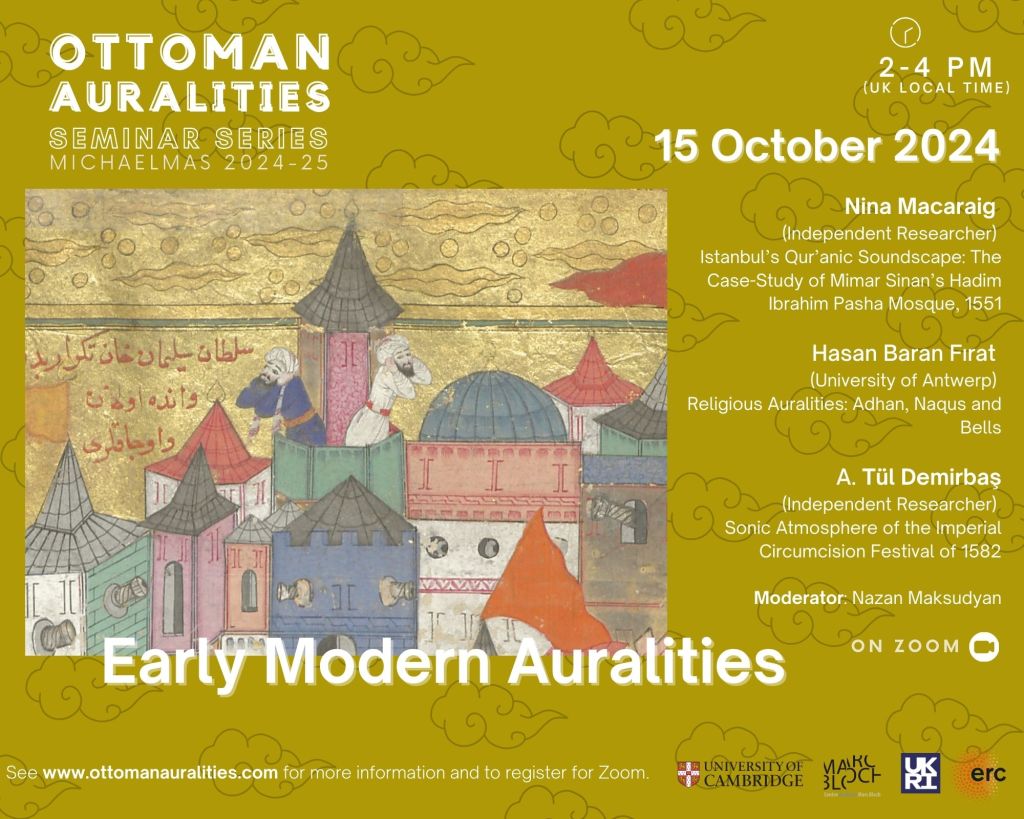
15 October 2024 | 2:00-4:00pm on Zoom &
in Lecture Room 1, Faculty of Music, University of Cambridge
Istanbul’s Qur’anic Soundscape: The Case-Study of Mimar Sinan’s Hadim Ibrahim Pasha Mosque, 1551
The architectural form of the mosques built by Mimar Sinan, the imperial master architect of the Ottoman dynasty between 1539 and 1588, clearly reflected to contemporary Ottoman viewers the status and wealth of the respective buildings’ patrons — in their majority members of the ruling elite and grandees. Not only the quality of construction and the craftsmanship displayed in the architectural details and furnishings, but also the presence and number of domes and minarets establish a hierarchy based on a certain “decorum,” as expressed by the art historian Gülru Necipoğlu. In addition to these two variables of the patrons’ status and the form and size of their establishment, their correlation to a third variable deserves closer scrutiny: that is, the role played by Qur’anic recitation, which after all was an integral part of the experience of mosque space, if one is to consider the mosques’ endowment charters (vakfiye) specifying the suras (chapters) and ayas (verses) to be read. This presentation will investigate whether there existed a hierarchy in recitation parallel to the hierarchy of architectural form. How did architectural patrons use sound in order to convey their status among the Ottoman elite? And, given that architectural form was regulated based on the rules of decorum, could small mosques make themselves bigger by housing a richer soundscape with a large number of reciters?
Religious Auralities: Adhan, Naqus and Bells
This study explores the impact of religious sounds on the historical soundscape of early modern Istanbul, with a primary focus on the adhan and its major counterpart, church bells, as well as the lesser-known semantron. These sounds, which embodied broader religious, social, and cultural values, played a pivotal role in daily life and political affairs. By examining how these sounds shaped the urban environment, the study reveals their influence beyond spiritual functions, extending into the realms of social and political life. As reactions from various communities evolved, both the Ottomans and religious minorities employed sophisticated strategies to control and amplify these sounds, ensuring they resonated throughout the city’s changing landscape.
Sonic Atmosphere of the Imperial Circumcision Festival of 1582
This presentation explores the multi-sensory celebrations organized in Istanbul in 1582 for the circumcision of Sultan Murad III’s son, Prince Mehmed. It analyzes historical sources to understand how the festival was conveyed and examines the role of sound in creating a festive atmosphere, as well as how sonic elements contributed to the representation of power.
Prof. Nina Macaraig retired from an Associate Professorship in the Department of Archaeology and History of Art at Koҫ University, Istanbul, in 2017. She has specialized in Ottoman architectural history, in particular the “lesser” monuments within its canon, such as bathhouses and soup kitchens, as well as sensory aspects of the built environment. In addition to editing numerous collected volumes, she has written award-winning articles on Ottoman sound- and smellscapes, as well as the monograph Çemberlitaş Hamamı in Istanbul: The Biographical Memoir of a Turkish Bath (Edinburgh University Press, 2019). Now living in California, she continues to contribute to academia as free-lance copy-editor while also working in the watersports industry.
Dr. Hasan Baran Fırat is a multidisciplinary researcher specializing in Architectural Acoustics, Historical Soundscapes, Urban Musicology, and Digital Humanities. He earned his master’s in Building Physics from Istanbul Yıldız Technical University and a Ph.D. in Architecture and Cultural Heritage from the University of Campania Luigi Vanvitelli. His award-winning dissertation focused on digitally reconstructing 18th-century Naples’ soundscapes. Dr. Fırat’s research explores early modern Istanbul and Naples’ aural traditions, blending urban musicology with architectural acoustics through digital methods. Currently a post-doctoral fellow at the University of Antwerp, his work on historical soundscapes is supported by the Marie Skłodowska-Curie YUFE program.
Dr. A. Tül Demirbaş holds a Ph.D. in Musicology and Interdisciplinary Cultural Studies from the University of Bern for her doctoral thesis titled “Sonic Representations of Power: The Role and Perception of Sound in the 1582 Ottoman Imperial Festival”. She earned her master’s degree in Ethnomusicology from Mimar Sinan Fine Arts University in 2015 and studied at Istanbul Technical University Musicology and Music Theory PhD program between 2016-2019. She worked in the Department of Musicology at MSFAU until she moved to Switzerland in 2019, where she was a scientific researcher for the SNSF project “The Sounds of Power” at the University of Bern. Demirbaş co-edited together with her project partner Margret Scharrer, Sounds of Power: Sonic Court Rituals In and Outside Europe in the 15 th -18 th Centuries (Böhlau Verlag, 2024). As an independent researcher, Demirbaş is currently working on the publication of her doctoral dissertation and pursues different projects in the fields of early music education and music geragogy.
 Ottoman Auralities