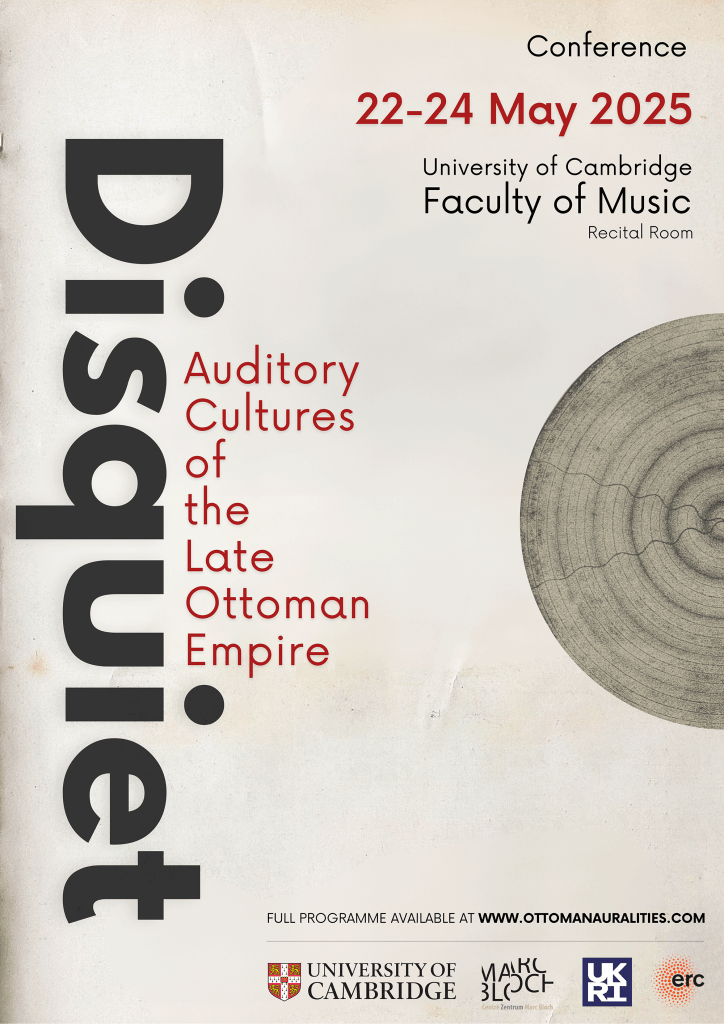
Disquiet: Auditory Cultures of the Late Ottoman Empire
22-24 May 2025 | University of Cambridge, Faculty of Music
The history of the late Ottoman Empire is a period of dramatic political and cultural change, often framed as a series of “modernizing” reforms. A key site of contestation and index of those changes were the empire’s auditory cultures: how inhabitants of the Ottoman lands and their neighbors listened, produced sound and music, and shaped their cultural lives in and through sonic activities and discourses. Many well-known political reforms had significant sonic components, such as the abolition of the Janissary Corps and the attendant transformation of state (and Sufi) music making, or the Reform Edict of 1856, which, among other reforms, permitted Christian communities to ring bells publicly, a departure from earlier practice.
The challenge of writing such sonic histories has already been taken up in related ways by historians such as Nina (Ergin) Macaraig, in her groundbreaking work on the sonic dimensions of early modern Ottoman mosques and imperial spaces. More recently, Ziad Fahmy (2020), writing about Egypt in the late 19th and early 20th centuries, has shown how a whole range of societal changes in urban spaces, including infrastructures, technologies, and governmental reforms, continually reshaped the sonic experience of residents of Cairo and Alexandria.
Sound studies raises further questions still: how did practices of medicine and science relating to voice and hearing emerge in this period? How do communication systems of this period (messenger networks, the postal system, telegraphy, early telephony) relate to or rely on sound? How were listening practices transformed in this era, especially in response to changes in social/public spaces? Beyond (in)famous tropes such as howling dogs, what kinds of sonic environments were audible in this period, and how might attending to sound further discussions in environmental history of the region? To what degree are forms of cultural difference (e.g., gender, sexuality, race/ethnicity, class, and disability) audible in this period? What forms of sonic performance—including music, theatre, and religious recitation, but also going beyond them to consider reading (aloud), translation/interpretation, debate, and so on—can be observed?
These broad lines of inquiry underpin the ERC/UKRI-funded project, “Ottoman Auralities and the Eastern Mediterranean: Sound, Media, and Power in the Long Nineteenth Century.” In conjunction with that project, we are pleased to announce an upcoming conference, “Disquiet: Auditory Cultures of the Late Ottoman Empire,” to be held 22-24 May 2025 at the University of Cambridge. In this conference, we aim to explore the manifold auditory histories of the late Ottoman Empire and surrounding eastern Mediterranean. In doing so, we hope to further elucidate possibilities for sound studies and global music history to engage more substantively with the Ottoman Empire as part of a broader “remapping” impulse (see Steingo and Sykes 2019), and for Ottoman history to deepen its understandings of the sensory and phenomenological experiences of the long nineteenth century, including those official social reforms as well as other shifts in science, medicine, and technology.
For any questions, please email us at ottomansound@mus.cam.ac.uk
Peter McMurray, Principle Investigator
Nazan Maksudyan, Senior Research Associate
Vanessa Paloma Elbaz
Onur Engin
Jacob Olley
Hande Betül Ünal
 Ottoman Auralities